Friday, December 1, 2017

"This is the malt ..

House  malt  rat  cat  dog  cow  maiden  man  judge  rooster  farmer  HHH

..that lay in the house that Jack built .. "


 Synoptic Simplicity
"What-you-see-is-what-you-get" - an Earth getting bigger.
Crustal dislocation, spreading by extension and mantle growth.


Fig.1.  Three axes of Earth rotation result from Pacific extrusion (/mantle growth) and pivoting apart of Earth's hemispheres. Further complication results from crustal dislocation, differential rotation of northern and southern hemispheres, and Atlantic dilation (not shown).
( "Reading the Runes" => 'Cow' )


house  malt  rat  cat  dog  cow  maiden  man  judge  rooster  farmer  hhh

Sunday, November 26, 2017

This is the house that Jack built

House  malt  rat  cat  dog  cow  maiden  man  judge  rooster  farmer  HHH

"What you see is what you get .."
( .. an elephant that cannot speak its name .. )


Fig.1.  The Elephant in The Room -  Planet Earth, getting bigger than it used to be.  [Mechanism unknown - so nobody talks.]

The edifice of the mind and its structuring of common sense (or rather its 'un-structuring') - the way it goes round-and-round in circles talking around something that everybody knows is there to be talked about, but because we don't know exactly what it is we don't know (or refuse to admit or recognise it), we can't properly talk about it - .. has form of course .


=> Read more

house  malt  rat  cat  dog  cow  maiden  man  judge  rooster  farmer  hhh


Thursday, November 9, 2017

Sumo wrestlers - India and China

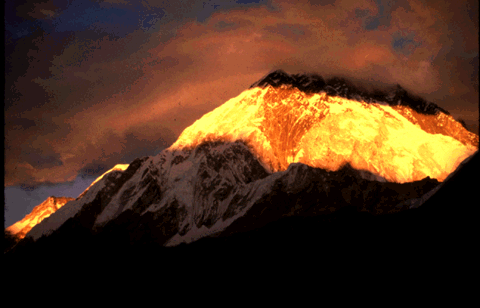
 Mountain 'building' in the Himalayas 
( .. Continental collision - suffused in the golden glow of wishful thinking .. )


"... Among the most dramatic and visible creations of plate-tectonic forces are the lofty Himalayas, which stretch 2,900 km along the border between India and Tibet. This immense mountain range began to form between 40 and 50 million years ago, when two large landmasses, India and Eurasia, driven by plate movement, collided. Because both these continental landmasses have about the same rock density, one plate could not be subducted under the other. The pressure of the impinging plates could only be relieved by thrusting skyward, contorting the collision zone, and forming the jagged Himalayan peaks...." (link)


Fig.1.  Mount Everest. This is the image offered by the USGS to illustrate the point  of "thrusting skyward, .. contorting the collision zone". (Image from the website of the USGS) (20170927). [Nice pic., but not very informative re."thrusting skyward".]

"Contorting"? "thrusting skyward"? - indeed, .. Just in case you would like to see what is meant by 'contortions' and 'skyward thrusting', the USGS show them suffused in the golden glow of sunset.  Nice pic., but not very informative re. "contorting".  Here is better.  You really have to hand it to them, don't you, ..for sheer unadulterated nonsense. (I always thought the jagged peaks were a result of erosion.  You? ..  And just see that flat horizon!) (smooth Earth) ("flatter than it used to be.")

T.L. Morton (1996) spices it up a bit, likening it to gladiatorial combat:-


Fig.2.  Continents in collision at a convergent plate boundary.  "Like the meeting of two Sumo wrestlers, continental collision stands the crust straight up, slowly giving rise to high mountains.  As the crust is forced upwards it bends, buckles and twists..."

"The two sumo wrestlers enter the ring. Crouching, they watch each other like strange dogs meeting in an alley. Slowly they circle, grunting and flexing, beads of sweat glistening on their broad, oiled shoulders. In a sudden explosion of muscle they charge forward, flesh collides with flesh and the Earth shakes. The impact stands both wrestlers straight up. Straining and pushing they jockey for leverage and position - bulk against bulk = huge and proud. 

 "India and Asia met in this manner. Buckling, bending and twisting the crust the collision stood the two continents straight up and the Himalayas slowly rose. Continent colliding with continent forms mountains of buckled, bent and twisted rock; the Appalachians are mere remnants of such a collision, whereas the Alps, still tall, speak proudly of the collision between Africa and Europe."(Extract from T.L. Morton, 1996, Music of the Earth, Plenum Press, 312pps)


Well, ..you know, ... What can you say? The point is that publishers actually publish this stuff, in the interest of educating the public, and then scientists complain about Christian fundamentalism taking hold in our schools (footnote*). Why shouldn't it (take hold), with rubbish like the above being peddled to appeal to the public, and prepare schoolies for the real deal once they go to uni to 'study' how. There's probably a case for a kindergarten 'activity' in there too, given the "clashing" and "trashing" that masquerades as 'sport' these days. 


This is every bit as ludicrous as the ten centimetres of dyke intruding the ridges every year moving the continents, or helping to push the ocean floors down subduction zones, ..and would be funny if it were not firmly ensconced in the sanction of academia, and were it not factually incorrect: the mountains of the Himalyan front are as much flat or slightly tilted as is much of the Alpine region of Europe, as they are bent, buckled and twisted.  Moreover the pull-apart of the Mediterranean lying between Africa and Europe mark this as as a zone of extension, not compression, ...as does the Persian Gulf lying between Saudi Arabia the Zagros Mountain chain - and the Ganges Basin in front of the Himalayas.

The Himalayas are collapsing from a once-curvature of the Earth that was tighter than that of the present day.


Mountain *building* by plate collision is a *MYTH*


Tuesday, October 24, 2017

Plates and plate movement

 Kiddies' Korner 
( .. the language of plates, .. as used in Plate Tectonics .. )


Nope. Plates don't "move".  Not the way Plate Tectonics says anyway, to "collide and build mountains".  And if the crust /continent on top does, then so what? The crust on top is not a plate, and may 'move' for reasons other than 'Plate Tectonics'.


Fig.1.  Caterpillar tracks.  Just because its trax are churning like billy-o doesn't mean this baby is going anywhere. .. just round-and-round like the lithospheric plate of  Plate Tectonics.  It's stuck in mud.  No way can it even make it to the edge of the page to "collide" with and "crumple" another plate'.  So plate *movement* as Plate Tectonics needs it to be, to "build mountains", is a non-starter.  When it comes to "crumpling", *PLATES* simply don't "move".   Not according to Plate Tectonics use of the language anyway.  Convection cells don't move any more than an escalator might move out from the shop on to the street to "collide" with buildings.  And if they're "moving" on the spot then they ain't goin' no-where - much less 'drfting /gliding /diving /riding /smashing /banging /bumping or travelling across the world to collide with other 'plates' (and build mountains). 

Google search


"plates move" + tectonics
~2006       2017 


"Plates move" 6,770         201,000
"plates collide 3,800           74,100
"plates slide 2,430           58,500
"plates converge" 1,630           69,300
"plates float" 1,170           28,100
"plates drift" 624              19,000
"plates dive" 624                1,020
"plates ride" 637                2,490
"plates grind" 600              22,000
"plates crash" 423              12,500
"plates crunch" 107                   371
"plates creep" 798                   287
"plates glide" 148                   670
"plates jostle" 78                  1,240
"plates slam" 198                   319
"plates ram" error                 216
"plates smash" error              3,800
"plates bang"lost                   139
"plates bump" 2,940 (2012-10-17)  1,510
"plates travel" 936                1,090
"plates migrate" 2,440                706
("plates scurry")

Did not match any documents (no legs!)

And the language that *should* be used (something like "cycling") (for convection) - or even 'convect' itself, is not used.


Plates don't do any of the above verbs (not even "scurry") (so they win one on that score at least).  So Plate Tectonics runs foul of semantics again (repeat link).  All the words used are words of *translation*, which convey a completely wrong meaning of "plate movement" - particularly when it comes to the Origin of Mountains.

Fig.2. One for that dinner table conversation - Plate movement according to the lingo of Plate Tectonics. If a plate with dinner on it collides with another plate (with dinner on it), then the dinners heap up around the collision ("/crashing /crumpling /creeping) .. (jostling /smashing /ramming /bashing"), .. while one of the plates slides /glides beneath the other.

Well, .. it's what they say, .. not me.  Do me a favour and tell me if that image is basically your understanding of "plate movement" according to the liturgy.)  We can cuddle each other for support in this post-Trumpian apocalyptic /apoplectic Armageddon we're headed for.


====================

[20180609]
I sketched that figure after listening to two programs today, 1 : Universities and private money  and 2 Bespoke bodies  (from about 29mins on the second one for the general overview), in order to highlight the question, how can such practical medical research co-exist with such dopey nonsense as Plate Tectonics?  Somebody tell me it's me that's the dope (I don't mind), because the alternative is unthinkable, except that it is (thinkable). Unfortunately.  Eventually it will be shrugged off as "the way science moves forward", but before that happens the parlous state of Plate Tectonics should be recorded for posterity.  It should not be allowed to slip under the radar and be forgotten about without being held to account, with which in mind the BBC science /Earth department got noticed for its take on "colliding plates building mountains".  [The link on that twitterpost has moved b.t.w. to https://www.bbc.co.uk/programmes/p00fzsnd ]

 However, its reference to the wikipedia appears to be a disclaimer of sorts apologising for the clips being possibly factually incorrect, and suggesting some correction may be needed.

It's true. They do.

The Wikipedia is in a bit of a bind on that score, being skewered on the semantics of "mountain formation" v. "mountain building", which difference highlights something of the trap that Plate Tectonics has fallen into with its tectonics of crustal crumpling.  Fine, if primary school is the intended level of pitch, but for anything more they need a slap on the wrist because 1. they are abusing the public's intelligence, 2. casting aspersions on Professor Ian Stewart's standing as a science communicator (the script is just a generic consensus view)  and 3. knocking a hole in the public purse by taking him  all the way to New Zealand to read it. The offending passages (about moving plates, continental collisions buckling the crust and building mountains) are highlighted :-


Fig.3.  'Plates', the washing up, and who's doing it, .. the 'boing-boing' of plate collision (Fig.2 above)? .. or the gravitational instability of Earth expansion.  A toss-up?  (No that's not fair, .. just look at that mess on the left.)  In the interest of order, peace and  harmony, Earth expansion will volunteer.

=====================
.

Monday, October 23, 2017

The Misnomer of Mountain Building

 Blue Mountains, Australia
( ...  which are neither blue, nor particularly mountainous .. )


My dictionary says mountains are just big hills.   Geologists talk glibly enough of mountain building, ...so why don't we talk of hill-building? ...but we don't, ..do we?  Ever wonder why not...? The answer is couched in the biblical belief in Plate Tectonics. 


Fig.1. Blue Mountains, Australia .. (through a mist .. darkly). ["Plates and mountains" - (Cowboys - pulling the wool, drawing the long bow.) ]

Who remembers the good old days (Grampaw?) when mountains were just high bits of ground?  At least, higher than everywhere else.  Which was funny when you thought about it, ...because .. how come?   How did it happen that great chunks of land were higher than everywhere else?  And when you thought about it,  mountains were not really mountains at all, but just wot wuz left when there wuz valleys.  And you got valleys when it rained.    And that was what *really* made them pointy and steep (The mountains.)  The valleys.  Well, ... those fluffy clouds up there, .. sun, .. evaporation, .. condensation, ..rain-wind-and-weather, .. and climate (.. change) ..


(Then there wuz Geolorgie... an' Plate Tectonics)

"Now, ..WaaAit a Miiiinute!  What are we talking about here?  The mountains or the valleys?"
"NawwwWww, ....rain,  ....weather, ...erosion,  ... climate (change), global warming,  ..grass growing and slowing erosion and helping mountains grow, ..  Sea-level. ... "
"Sea-Level?  Is the sea level?   I thought it was round like the Earth."
"Yeah, ....Gravity.   It's been round for ever.  Ever since the planet."
"Yeah?"
"Yeah....  Well, ... sort of, ...it's kind of like, ..yeah, .. That's why its level.  At least, it's becoming level."
"Yeah?"
"Yeah, ... an' you get fossils everywhere, showing every so often the sea comes up and swamps the land.  ..I mean levels the land."
"Gee, . How?  Does it really rain that fast?"
"Yeah, ..  Forty days and forty nights.  It's true."


P.T.-ers, ..Pteros, Pterologists, Pteromancers, Pterrorists 
..and the avant garde, ..the Hill-Buildies,... 
...snoring away like Rip Van Winkle..